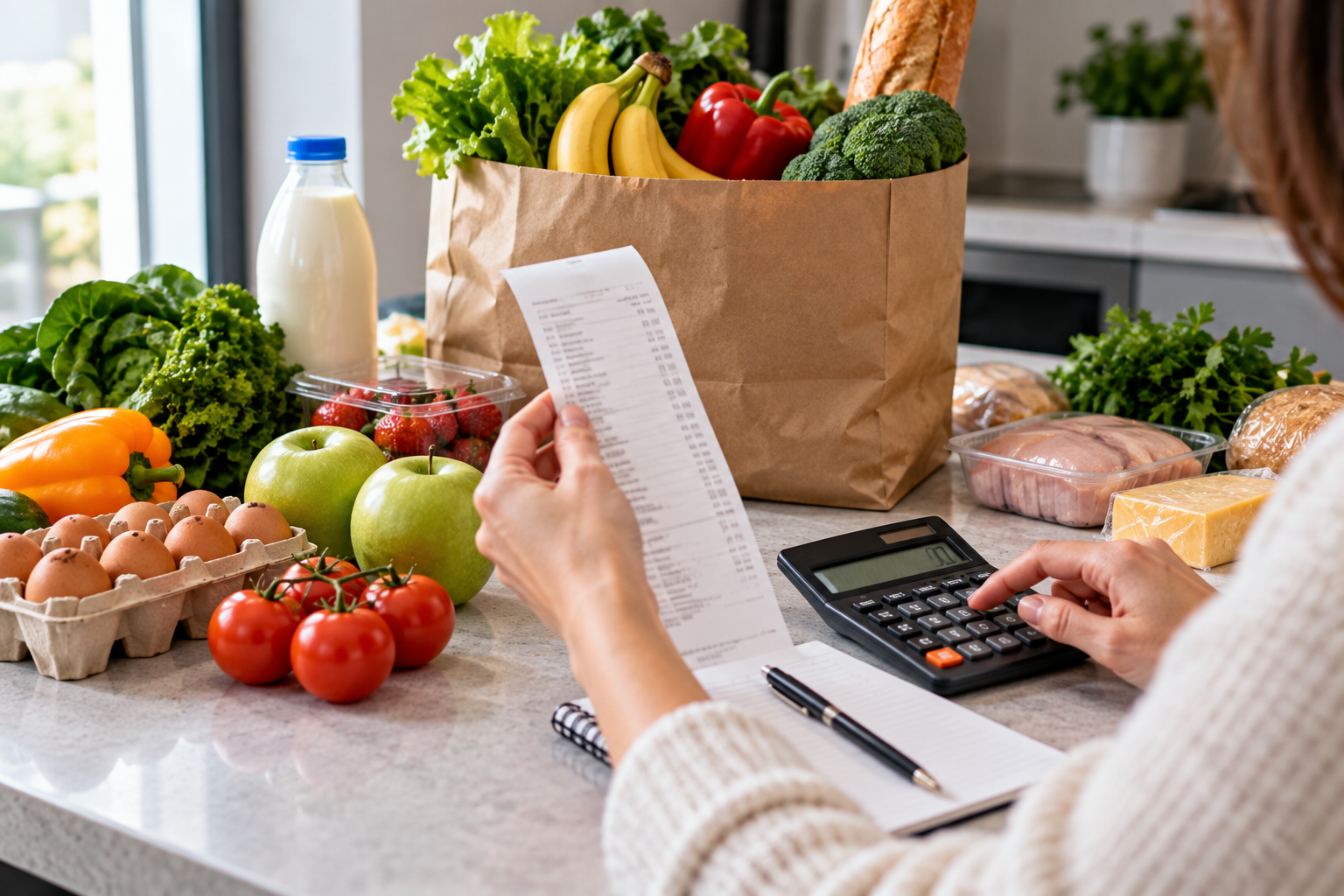
The best way to save money on groceries is to plan what you will actually use before you shop. Check your pantry, fridge and freezer, build meals around food you already have, make a shopping list and compare unit prices at the store. Store brands, sales and bulk purchases can lower your grocery bill further, but only when you would have bought and used those products anyway.
A practical routine looks like this:
- Check what you already have.
- Set a realistic grocery budget.
- Plan several meals.
- Make a shopping list.
- Compare unit prices.
- Try selected store brands.
- Use sales strategically.
- Buy in bulk selectively.
- Reduce impulse purchases.
- Waste less food.
Start by Tracking Your Grocery Spending
Before changing your shopping habits, find out what your current grocery bill actually looks like.
Review several weeks of purchases from supermarkets, grocery delivery services, warehouse clubs and smaller convenience-store trips. Keep restaurant meals and takeout separate if your goal is specifically to reduce grocery spending.
Look for patterns rather than immediately setting an arbitrary savings target.
Questions worth asking include:
- Which categories take up the largest part of the bill?
- Which products do you buy every week?
- How much is spent on unplanned items?
- Are you making several small grocery trips between larger shops?
- Which foods regularly expire before you use them?
If you discover that a noticeable share of your spending comes from drinks, snacks or forgotten perishables, you already know where the first savings are likely to come from.
Check Your Pantry, Fridge and Freezer First
The cheapest grocery item is often the one you have already paid for.
Before planning meals, check what is in your pantry, refrigerator and freezer. Look especially for produce, dairy products and opened packages that should be used soon.
A simple order is:
use first → plan around it → buy what is missing
For example, if you already have rice, frozen vegetables and half a package of chicken, you may need only a few additional ingredients to turn them into a meal.
This reduces duplicate purchases and gives food that is already in the house a better chance of being eaten.
USDA MyPlate also recommends checking food on hand before planning meals and making a shopping list as part of budget-conscious meal planning.
USDA MyPlate — Healthy Eating on a Budget
Plan Meals Before You Shop
Meal planning does not need to mean creating a complicated 30-day calendar.
Plan enough meals to cover the period until your next main grocery trip. Start with ingredients already at home, then choose recipes that share some ingredients.
If you buy cilantro, vegetables or chicken for one dinner, think about whether the remaining amount can appear in another meal later in the week.
It also helps to include:
- one meal based mainly on pantry or freezer ingredients;
- a plan for leftovers;
- one simple backup meal for a busy day.
The goal is not to predict exactly what everyone will want to eat seven days from now. It is to make sure most items entering the cart already have a purpose.
Without a meal plan, shopping often becomes a collection of foods that individually look useful but do not necessarily combine into actual meals.
Make a Grocery List and Stick to the Plan
Make your list after checking your supplies and planning meals.
That sequence matters. Otherwise, the list can simply reproduce your usual purchases without accounting for what is already sitting in the kitchen.
Organizing the list by store section can make shopping easier:
- produce;
- dairy;
- meat or other proteins;
- pantry;
- frozen foods;
- household items.
A list reduces forgotten essentials, duplicate purchases and the amount of time spent deciding what to buy in each aisle.
It does not have to be completely rigid. A lower-cost substitution or genuinely useful sale may justify a change. The point is to have a reason for adding something that was not planned.
Compare Unit Prices, Not Just Package Prices
Shelf prices can be misleading when package sizes differ.
The unit price shows what an item costs per comparable amount, such as per ounce, pound, kilogram or individual unit.
Imagine two packages of the same food:
- 18 ounces for one price;
- 24 ounces for a slightly higher price.
The larger package may offer better value, but you cannot know from the total price alone. Compare the price per ounce.
NerdWallet recommends using unit prices when comparing package sizes and stores rather than relying only on the sticker price.
NerdWallet — How to Save Money on Groceries
Unit pricing is particularly useful for products you buy frequently because even a small difference can matter over many purchases.
There is one more check: will you actually use the larger quantity? A lower price per ounce is not much of a bargain if half the package eventually goes in the trash.
Try Store Brands Instead of Name Brands
Store brands can reduce the cost of many routine purchases without requiring you to replace everything you like.
Good categories to compare include:
- rice;
- pasta;
- canned foods;
- flour;
- sugar;
- frozen vegetables;
- basic dairy products;
- pantry staples.
Compare ingredients, package size and unit price rather than assuming that either the national brand or generic version is automatically better.
You also do not need to change the entire cart in one trip. Try replacing two or three frequently purchased products first.
If you like the alternatives, keep buying them. If the quality difference matters to your household, switch back and look for savings elsewhere.
Use Sales and Coupons Strategically
A promotional sign does not automatically mean the item belongs in your cart.
A sale is most useful when:
- the product was already needed;
- the discounted price is genuinely competitive;
- the quantity will be used;
- buying extra will replace a future full-price purchase.
Compare the sale price with the store-brand unit price as well. A branded product marked down by 20% may still cost more per ounce than the regular store version.
Digital coupons, loyalty programs and store apps can help with products you buy anyway. They become less useful when they encourage extra spending simply to activate a discount.
A “buy two, get one free” offer is not a meaningful saving if the third package expires unused.
Buy in Bulk Only When the Math Works
Bulk buying can reduce the unit price, particularly for products that your household consumes regularly.
Possible candidates include:
- rice;
- oats;
- pasta;
- canned foods;
- frozen foods;
- frequently used pantry staples.
Before choosing the largest package, ask three questions:
Is the unit price lower? Will we use all of it? Do we have somewhere to store it?
Be more cautious with fresh produce, bakery items, refrigerated foods and unfamiliar products.
A warehouse-sized container that lasts far longer than expected can tie up money and storage space without generating real savings.
Reduce Impulse Purchases
Small unplanned purchases can quietly increase a grocery bill.
Common examples include:
- checkout snacks;
- individual drinks;
- new products bought out of curiosity;
- seasonal displays;
- items added during several small trips during the week.
Shopping from a list helps, but you can also try keeping a running total as you shop or reducing the number of grocery trips you make.
Some people spend less when using grocery pickup because they are not walking past promotional displays and impulse items. Bankrate includes curbside pickup among possible ways to limit impulse spending, while noting that shoppers should watch for fees.
Bankrate — Ways to Save Money on Groceries
Pickup or delivery only saves money if the fees, markups and minimum-order requirements do not cancel out the reduction in impulse buying.
Choose Convenience Foods Selectively
Prepared and pre-cut foods have legitimate value. They save time and can make cooking more realistic during a busy week.
But convenience usually deserves a price comparison.
Look at items you buy regularly, such as:
- whole vegetables versus pre-cut versions;
- block cheese versus shredded cheese;
- dry staples versus ready-to-heat versions;
- ingredients versus fully prepared meals.
You do not need to prepare everything from scratch. Focus on the convenience products where doing a little extra work is realistic and the price difference is large enough to matter.
Paying more for convenience can still be a rational choice when it prevents takeout or makes it more likely that food will actually be eaten.
Compare Fresh, Frozen and Seasonal Foods
Fresh is not automatically cheapest, and neither is frozen.
Compare different forms of the foods you buy. Depending on the product and season, frozen vegetables or fruit may cost less and last considerably longer.
Canned products can also be useful for foods that would otherwise spoil before you finish them.
Seasonal produce may offer good value, but prices vary by location and store. Instead of memorizing a rule that one format is always cheaper, compare fresh, frozen and canned versions when all three would work for the meal.
The best value is usually the combination of reasonable price, useful quantity and low risk of waste.
Waste Less Food
Reducing waste can lower your grocery bill without changing what you like to eat.
Food that was bought at a discount but thrown away still consumed part of the budget.
To reduce waste:
- use older perishables first;
- plan meals around food that needs to be eaten soon;
- freeze appropriate leftovers and ingredients;
- avoid buying more fresh food than the household normally uses;
- store food properly;
- schedule occasional “use-it-up” meals.
Before each main grocery trip, identify two or three foods at home that should be used first. Then build at least one meal around them.
This also gives you better information for future shopping. If spinach is thrown out every second week, the solution may be buying less rather than finding cheaper spinach.
Shop Around — But Count the Real Cost
Knowing which stores offer good prices can help, especially for products you buy frequently.
But saving a few dollars does not necessarily justify driving to several supermarkets every week.
Consider:
- transportation or fuel;
- travel time;
- membership fees;
- delivery costs;
- minimum-order requirements.
A simpler approach is to identify one or two stores that are consistently competitive for the categories your household buys most often.
You can then use occasional promotions elsewhere when the saving is substantial enough to justify the extra trip.
Quick Checklist to Lower Your Grocery Bill
Before shopping:
-
Check the pantry, fridge and freezer
-
Plan meals
-
Set a spending target
-
Make a shopping list
-
Check useful sales or coupons
At the store:
-
Compare unit prices
-
Check store-brand alternatives
-
Limit unnecessary impulse purchases
-
Buy bulk packages only when they will be used
At home:
-
Store food properly
-
Use perishables first
-
Plan how leftovers will be used
-
Check whether weekly spending is actually going down
Lowering a grocery bill usually comes from several small changes rather than one extreme cut. Start by buying less of what goes unused, compare unit prices on products you purchase regularly and plan meals before shopping. Once those habits become routine, store brands, well-chosen sales and selective bulk purchases can provide additional savings without making grocery shopping unnecessarily complicated.