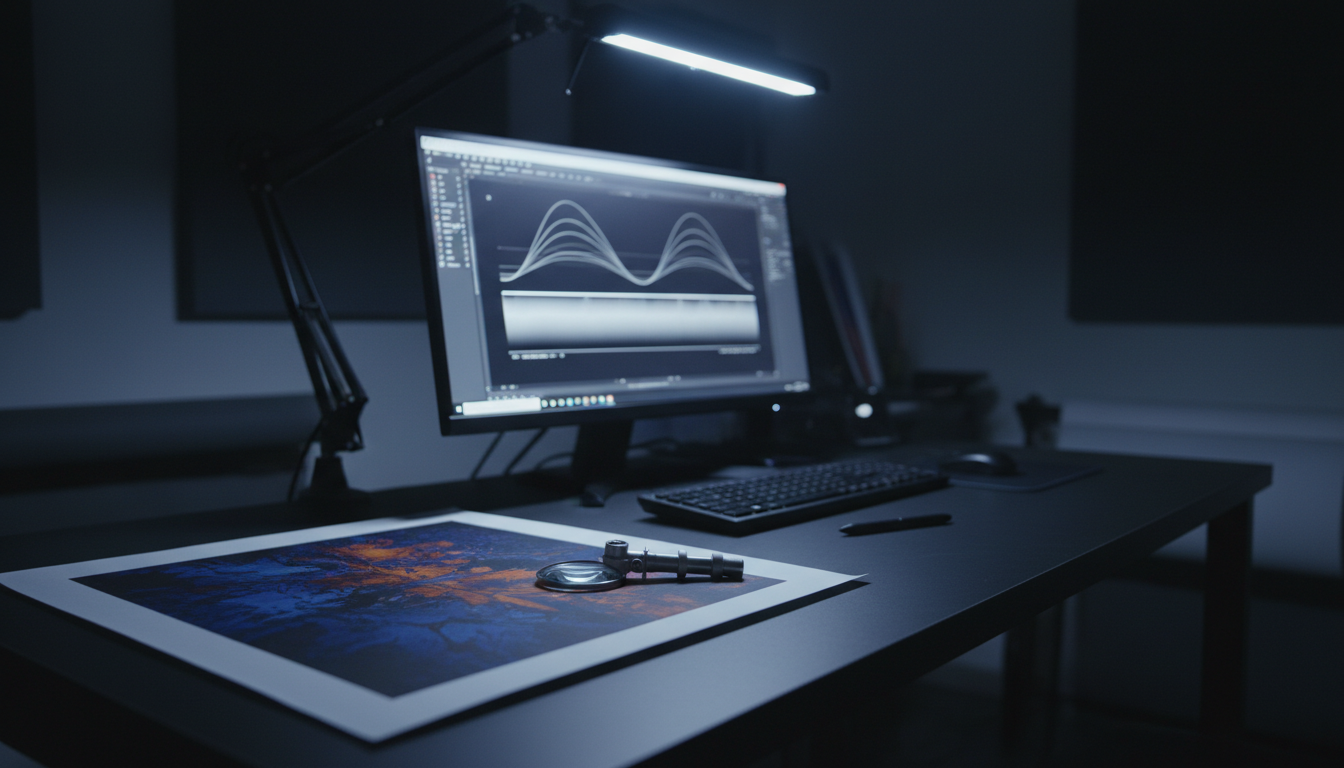
Direct manual healing treats local surface blemishes by pixel interpolation, whereas high-end photo retouch establishes a structural hierarchy across micro-texture, local shadows, and global color density. This distinction operates strictly within raster image manipulation rather than vector design or basic global exposure compensation. When clean-up moves from a controlled desktop calibration to varying real-world output channels, the tolerance for corrective intervention shifts fundamentally.
Output Media and Micro-Contrast Survival
A retoucher working on a calibrated 4K monitor views an uncompressed 16-bit TIFF at a one-to-one magnification ratio. In this controlled environment, slight residual unevenness in a portrait’s epidermal gradient or tiny flecks of airborne dust on a dark wool collar appear glaring. Removing every minor tonal inconsistency seems like the only responsible path. However, processing decisions made under these static monitor conditions face radically different constraints once the delivery destination changes from fine-art pigment printing to compressed mobile screens.
Consider the same source file output under two contrasting conditions while keeping the original capture resolution and color profile identical:
- Uncoated offset newsprint: Halftone screen dot gain inevitably fills fine shadow detail, while ink absorption softens transitions across skin tones. High-frequency frequency separation that looked crisp on a backlit screen dissolves, while aggressive micro-dodge and burn turns into muddy, irregular grey patches under standard 133-line screen printing.
- Backlit OLED mobile display: High brightness, dense pixel pitch, and automated browser compression sharpen micro-contrast. Subtle frequency blends that appeared smooth in studio lighting can generate harsh banding artifacts or over-sharpened halos when viewed at reduced physical dimensions under variable ambient glare.
The primary argument for standardizing a single, aggressive retouching pipeline is consistency: if a photograph is cleaned to the most rigorous standard at a pixel level, it ought to survive any subsequent downsampling or reproduction. In high-volume commercial production, establishing a single universal workflow reduces file management complexity and eliminates the overhead of producing bespoke master files for each distribution platform.
The Limits of Universal Pixel Correction
The strongest objection to this unified approach is that physical reproduction engines do not downsample linearly. When fine-frequency texture layers are scrubbed completely clean to achieve an immaculate finish on an expansive desktop display, the resulting surface lacks the tactile micro-variation needed to hold ink gracefully on paper. On porous stocks, an over-cleansed face appears flattened, because the physical grain of the paper replaces the missing organic high-frequency signal with random fiber texture.
Conversely, leaving organic low-contrast surface variations intact allows the image to absorb output compression without disintegrating into artificial-looking artifacts. What reads as acceptable subtle character under a soft studio backlight can turn into distracting blotchiness under the aggressive local sharpening algorithms used by modern content management systems. Clean-up cannot be treated as an absolute state of cleanliness; it is an equilibrium between capture fidelity and the physical behaviour of the target viewing substrate.
Returning to that original hierarchy across micro-texture, local shadows, and global color density, the depth of each layer is never neutral. A clean edit does not merely remove surface distractions in a vacuum. It balances tone and texture against the physical physics of the final medium, proving that an adjustment suitable for reflective paper can fail entirely once illuminated by an active liquid crystal matrix.